
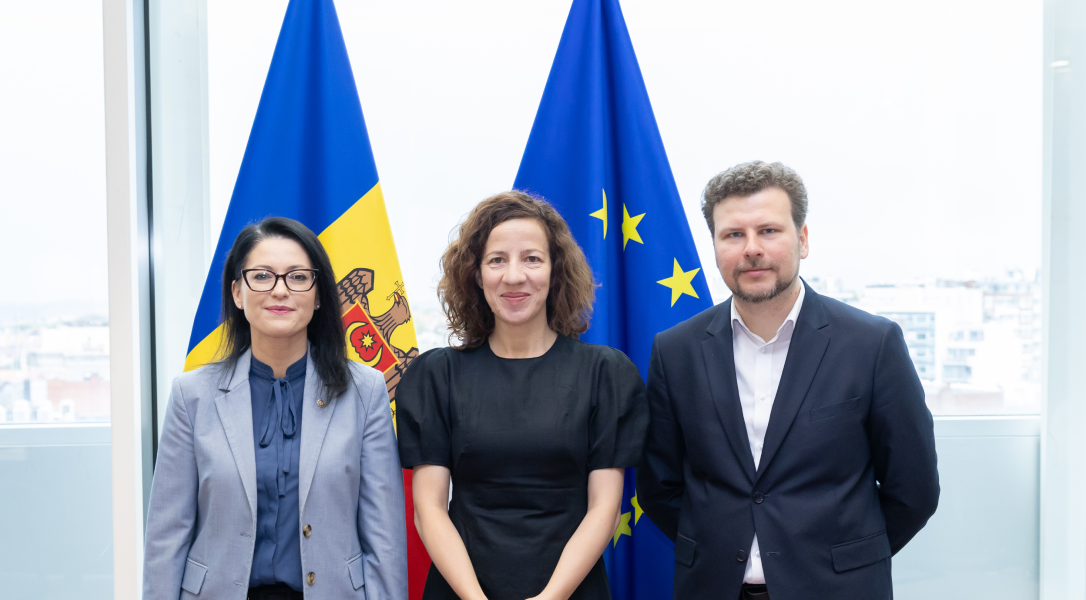
The Republic of Moldova and the European Union held a High-Level Dialogue on Education, Skills, Employment and Social Affairs in Brussels, bringing together Dan Perciun, Minister of Education and Research, Natalia Plugaru, Minister of Labour and Social Protection, and Roxana Mînzatu, Executive Vice-President of the European Commission for Social Rights and Skills, Quality Jobs and Preparedness.
The dialogue focused on reforms that directly impact people’s lives — from education and employment to social protection, inclusion and equal opportunities. It also provided an opportunity to review Moldova’s progress in aligning with European standards as the country advances on its path towards EU membership.
Accelerating Alignment with European Social Standards
Moldova is implementing one of the most ambitious social policy reform agendas among EU candidate countries. Over the past year, the country has significantly accelerated the alignment of its legislation with the EU social acquis under Chapter 19 – Social Policy and Employment and Chapter 2 – Free movement of workers.
Key Facts
- More than 30 EU legal acts are currently in the process of transposition;
- Reforming the legal framework governing the State Labour Inspectorate in line with ILO Conventions adopted in 2025;
- New labour legislation introducing stronger worker protection standards;
Strengthening Labour Mobility and Free Movement
A major milestone was reached in March 2026, when Moldova’s new law on the free movement and residence of EU citizens entered into force. This law establishes, for the first time, a comprehensive framework granting EU and Schengen nationals equal access to the Moldovan labour market and to general and VET education.
The country is also preparing for participation in European labour mobility mechanisms, such as EURES, EESSI, EHIC and strengthening cooperation with EU institutions.
Key Facts
- New free movement legislation entered into force on 18 March 2026;
- More than 100 residence permits issued under the new framework;
- 10 territorial employment offices designated as future EURES members;
- Alignment underway with ESCO occupational classification standards;
- 23 bilateral social security agreements signed, including 18 already in force.
Expanding Employment Opportunities
Creating jobs and helping people enter the labour market remains a national priority. Moldova continues to strengthen labour market policies, with a particular focus on women, young people, persons with disabilities and vulnerable groups.
Key Facts
- 20,733 people supported into employment in 2025;
- 9,392 women benefited from employment measures;
- National Employment Agency target of 25,000 supported placements in 2026;
- Long-term objective of integrating at least 100,000 people into employment over the next four years;
- Financial incentives introduced for young workers entering priority economic sectors.
Fighting Informal Employment
Recent reforms have strengthened Moldova’s capacity to combat undeclared work and protect workers’ rights.
Key Facts
- 3,453 labour inspections conducted in 2025;
- 8,086 undeclared workers identified;
- 6,206 workers subsequently formalised;
- Informal employment rate reduced to 17.3%;
- More than 12,000 individuals received labour law and workplace safety guidance.
Investing in Skills and Human Capital
Education and skills development remain central to Moldova’s European future. Current reforms focus on lifelong learning, digital skills, workforce reskilling and better alignment between education systems and labour market needs.
As Moldova develops a more competitive and innovative economy, investing in people remains one of the country’s most important priorities.
Key Facts
- Skills development integrated into labour market reforms;
- Lifelong learning placed at the centre of the new employment strategy;
- Financial incentives supporting youth employment;
- Stronger links between education policies and labour market needs.
Advancing Child Protection
Moldova continues to move away from institutional care towards family-based services and is preparing a new Child Protection Programme aligned with the European Child Guarantee.
Key Facts
- More than 85% reduction in the number of children living in residential institutions since 2015;
- Institutionalisation rate reduced to approximately 0.07% of the child population;
- 91.97% of children in planned placement benefit from family-based services;
- Second Barnahus Centre opened in Cahul in 2026;
- New Child Protection Programme for 2027–2030 under preparation.
Promoting Inclusion and Equal Opportunities
The country is also advancing reforms to support persons with disabilities, improve accessibility and strengthen independent living services.
Key Facts
- 6,988 personal assistance positions operational nationwide;
- 33 mobile support teams assisting approximately 995 beneficiaries;
- 29 protected housing services and 19 community homes in operation;
- Expansion of community-based and respite services underway;
- Draft legislation transposing the EU Accessibility Directive and the 2026-2030 National Programme for the Social Inclusion of Persons with Disabilities submitted for consultation.
Strengthening Gender Equality and Protection Against Violence
Moldova continues to align its legislation with European standards on gender equality and the protection of women and vulnerable groups.
Key Facts
- Criminalisation of femicide, forced marriage and stalking introduced;
- New legislative measures strengthening protection against domestic violence;
- 11 state-funded shelters operating nationwide;
- Shelter capacity increased from 178 to 214 places.
Protecting Vulnerable Families
Social protection remains a key pillar of Moldova’s reform agenda. Recent measures have focused on supporting vulnerable households, protecting families from energy poverty and expanding family support services.
Key Facts
- More than 21,500 vulnerable families supported in 2025;
- Over half of beneficiaries were families with children;
- Approximately 621,000 households received energy compensation during the 2025–2026 heating season;
- Family support programmes reached nearly 50,000 children between 2022 and 2025.
A European Future Built Around People
The High-Level Dialogue highlighted the depth of cooperation between Moldova and the European Union in areas that matter most to citizens.
From education and employment to social inclusion and child protection, Moldova’s reforms are bringing European standards closer to everyday life. As the country advances in its accession process, these reforms are helping build a more prosperous, inclusive and resilient European future for all Moldovans.